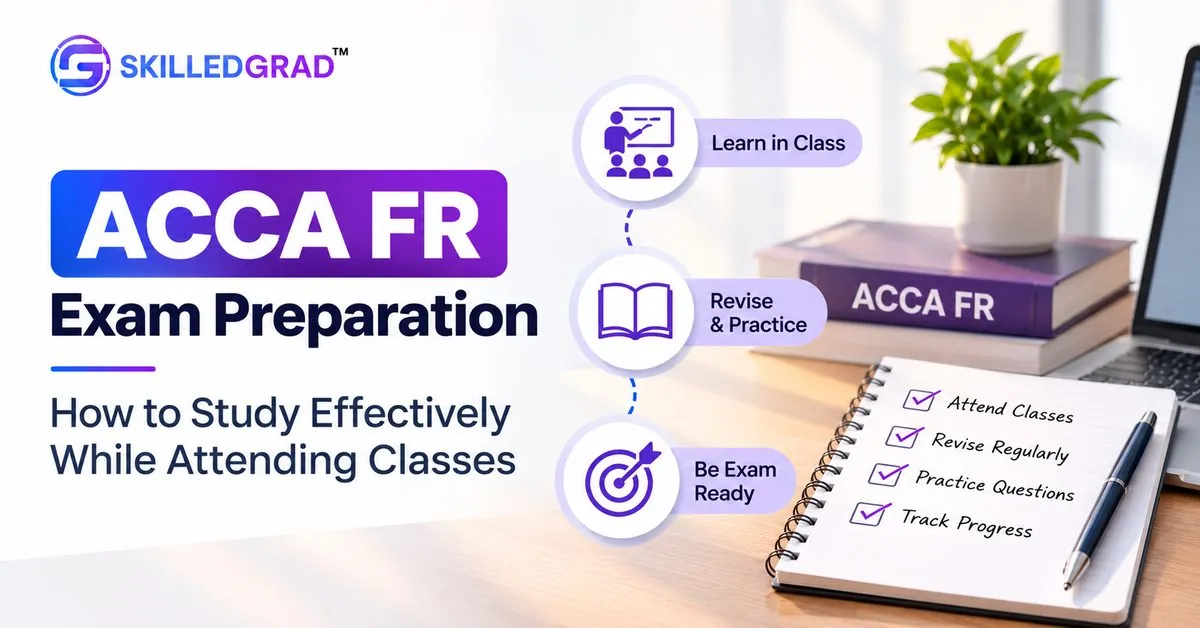

To study ACCA FR effectively while attending classes, skim each topic before class, focus on why each accounting treatment is required during class, and practise questions on your own afterwards while keeping a record of your mistakes. Use the ACCA Study Hub alongside your classes, build simple Excel workings for calculation-heavy topics, and revisit earlier topics every week.
Attending a class is not the same as learning a topic.
Contents
In ACCA Financial Reporting (FR), you may understand an accounting standard when your tutor explains it, but applying it independently in an exam question is a different skill. Your preparation during classes should focus on converting understanding into application.
This article works best when followed alongside the preparation steps in Part 2 and the final-month strategy in Part 4. Exam preparation works best when these stages are connected, rather than treated as separate activities.
Before the class: Come prepared
If the topic is available in advance, spend 10 to 15 minutes looking through it. Read the heading, understand the broad purpose of the accounting standard and identify unfamiliar terms. You do not need to master the topic before class. The objective is to make it easier to follow the explanation and ask relevant questions.
During the class: Understand the logic
Do not focus only on memorising accounting rules. Understand why a particular treatment is required and how it affects the financial statements. For example, when studying impairment, understand why an asset's carrying amount may need to be reduced. When learning revenue recognition, understand when revenue should be recognised and why the timing matters.
Whenever you study a topic, ask yourself:
What is the accounting issue?
What treatment does the standard require?
Why is that treatment appropriate?
How will it affect profit, assets, liabilities or equity?
Understanding the reasoning makes it easier to apply a standard when the exam question differs from the example discussed in class.
After the class: Practise independently
After completing a topic, solve questions without looking at the worked solution. Start with straightforward questions and gradually move to more challenging exam-style questions.
If you get a question wrong, identify the reason. Did you misunderstand the accounting treatment, miss an adjustment, make a calculation error or misinterpret the requirement? Keep a simple record of these mistakes and revisit them during revision.
Make use of the ACCA Study Hub
Use the ACCA Study Hub to support learning and revision. It provides digital study content and practice resources, including flashcards, quizzes and practice questions. Use it to reinforce topics covered in class, revisit concepts you find difficult and test your understanding as you progress.
Do not leave the Study Hub untouched until the final month. Using it alongside your classes makes it a more effective learning resource.
Use Excel to strengthen your understanding
If you are learning FR with Excel during your classes, do not restrict its use to the classroom. Make it part of your regular practice. Excel can help you understand how accounting calculations work, rather than simply memorising the final answer.
For example, when studying depreciation, create a simple schedule to calculate depreciation over an asset's useful life. When learning financial statement preparation, use Excel to organise adjustments and see how they affect the final figures. You can also use it to practise relevant calculations in leases, financial instruments and other FR topics as you progress through the syllabus.
Understand the accounting treatment first and then use Excel to organise and perform the calculations. Do not let the spreadsheet become a substitute for understanding the underlying accounting principles.
Maintain your own Excel workbook containing useful workings, calculation templates and examples from topics you have studied. Revisit and improve it as you progress through the syllabus.
Whenever you learn a calculation-heavy topic, ask whether building a simple Excel working will help you understand it better.
Revise earlier topics while learning new ones
Avoid completing a chapter and not revisiting it until the final month. Set aside time every week to revisit previous topics and solve a few questions. As you progress, attempt mixed-topic questions too. The exam will not always tell you which accounting standard to apply.
Follow the strategy consistently
Follow the advice in Part 2 before starting your preparation. Apply the methods discussed here while attending classes. Then use the structured revision and mock-exam approach in Part 4 during the final month. Do not wait until the exam is approaching to start taking your preparation seriously.
The objective is not just to complete the FR syllabus. It is to be able to apply what you have learnt when you sit for the exam.
Official ACCA resource: ACCA Study Hub and FR resources
Prepare with Skilledgrad
Classroom coaching at Purasaiwakkam and Tambaram, with structured classes, question practice, tests and one-on-one mentoring. Talk to us about the batch and exam window that suit you.