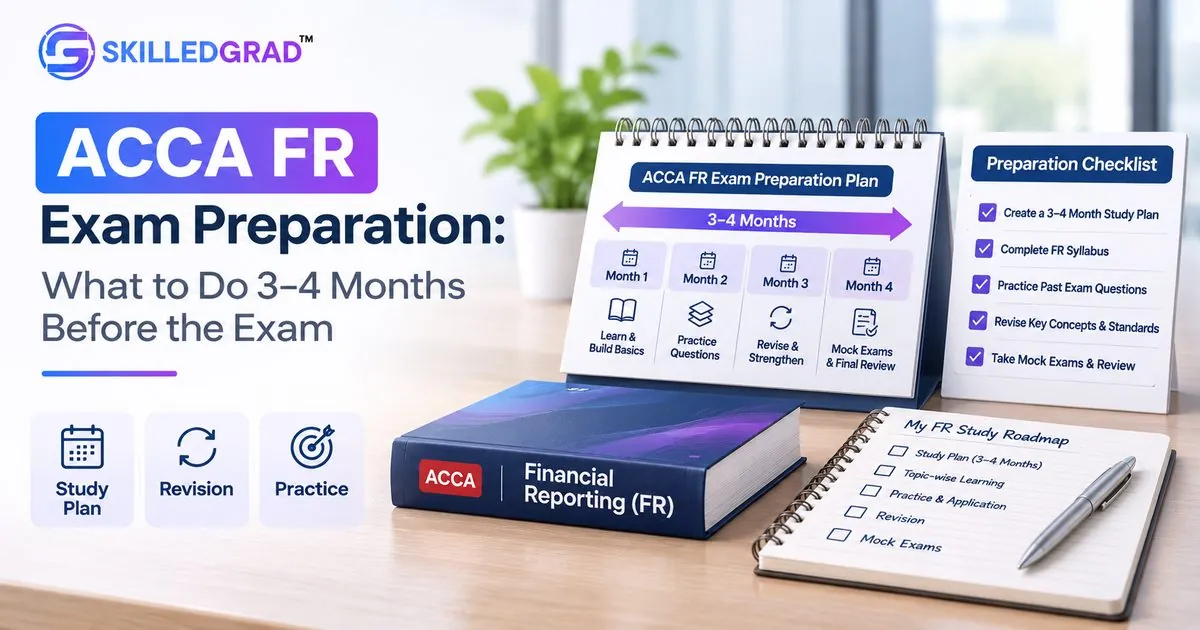

Three to four months before the ACCA FR exam, revisit your Financial Accounting (FA) basics such as double entry, the trial balance and year-end adjustments, read through the FR syllabus without trying to learn the standards in advance, plan backwards from your exam date with a realistic weekly schedule, and set up your study material so you are ready to learn FR once classes begin.
The best time to prepare for your FR exam is before you start studying the subject.
Contents
Many students begin preparing for Financial Reporting (FR) by opening the study material and starting Chapter 1. But a little preparation before the actual classes begin can make the entire learning process easier.
FR is not just about learning accounting standards. It requires you to understand accounting treatments, apply them to different situations, and prepare financial statements accurately under exam conditions.
Understand what you are getting into
If you have completed Financial Accounting (FA), you already have a foundation in accounting. FR builds on that foundation and takes you further into financial reporting, including the application of accounting standards and the preparation of financial statements.
Before starting, revisit the basics:
Double-entry bookkeeping and journal entries
Trial balance and the preparation of financial statements
Adjustments for depreciation, accruals, prepayments and inventory
Basic accounting concepts and the purpose of financial statements
You do not need to master everything again. The objective is to identify gaps in your foundation before moving into more advanced topics.
Get familiar with the syllabus
Take a look at the ACCA FR syllabus and understand the broad areas you will be studying. You will encounter individual accounting standards, financial statement preparation and group accounting, among other topics. Do not try to learn the standards in advance. Simply familiarise yourself with the syllabus so that the subject feels less unfamiliar when classes begin.
Set your exam target early
If you intend to sit for a particular exam session, plan backwards from the exam date. Allow sufficient time for learning the syllabus, practising questions and completing revision. Your preparation should not depend entirely on when the classes finish.
Decide how much time you can realistically devote to FR every week. A consistent schedule is more useful than an ambitious timetable that you cannot follow.
Set up your study resources
Keep your study material, question-practice resources and a dedicated notebook or digital document ready. For every accounting standard you study later, you should be able to record three things:
What is the accounting treatment?
Why is that treatment required?
How does it affect the financial statements?
The objective before classes begin is not to study FR in advance. It is to make sure you are ready to learn FR effectively.
A strong foundation, a clear understanding of the syllabus and a realistic study plan can make a meaningful difference to your preparation.
If you have not yet looked at how the exam works, start with Part 1: the FR exam format. Once classes begin, follow Part 3: how to study effectively while attending classes, and in the last few weeks, Part 4: what to do in the final month.
Prepare with Skilledgrad
Classroom coaching at Purasaiwakkam and Tambaram, with structured classes, question practice, tests and one-on-one mentoring. Talk to us about the batch and exam window that suit you.