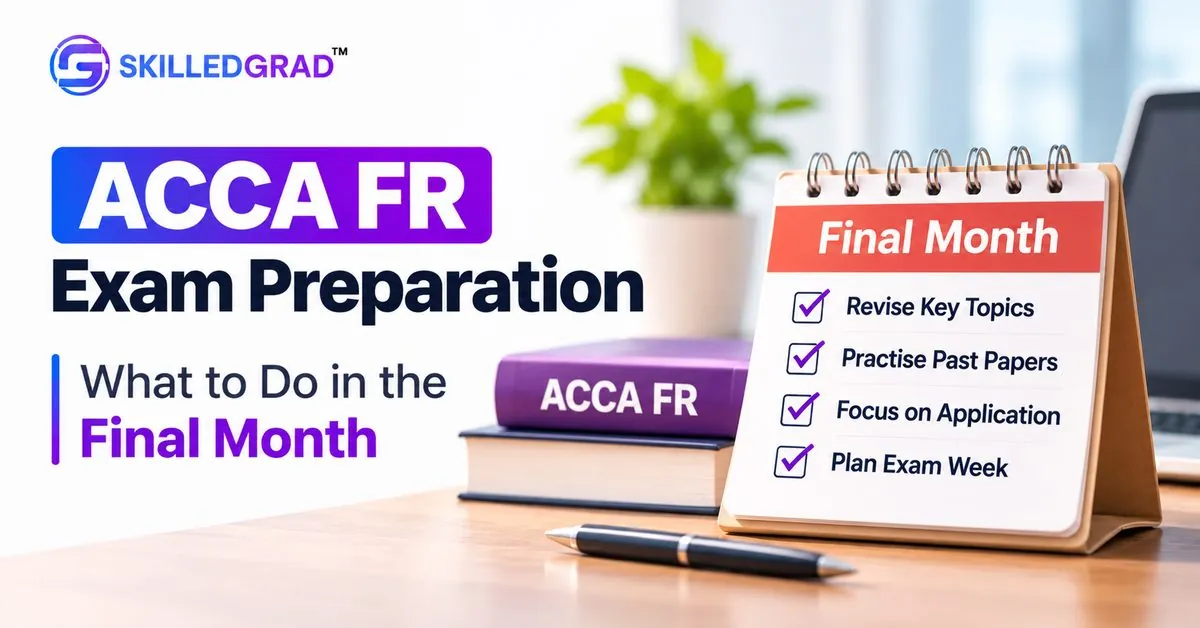

In the final month before the ACCA FR exam, shift from learning to exam performance: find your weak areas in week 1, focus on exam-style question practice in week 2, attempt the specimen exam and a pre-mock on the ACCA Practice Platform in week 3, and refine weak areas and key workings in week 4. Treat a mock score as feedback, not a prediction.
One month before the exam, your preparation needs to change.
Contents
- Week 1: Identify your weak areas
- Week 2: Focus on question practice
- Week 3: Use the ACCA Practice Platform, specimen exam and pre-mock
- Week 4: Refine your preparation
- Continue using Excel, but practise in the exam environment too
- In the final few days
- A mock score is feedback, not a prediction
- Follow the complete preparation journey
- Official ACCA resources:
Until now, the focus has been on learning the syllabus. In the final month, the focus should shift towards revision, question practice and exam performance. This is not the time to start preparing from scratch for every topic. It is the time to identify weaknesses, strengthen your understanding and practise applying what you know under time pressure.
Week 1: Identify your weak areas
Review the syllabus and assess your preparation topic by topic. Which accounting standards do you understand well? Which topics require another revision? Are you comfortable with financial statement preparation and group accounting?
Do not assume that a topic is strong simply because you understood it during class. Attempt questions to test your actual understanding. Use the results to decide where your revision time should go.
Week 2: Focus on question practice
Spend a substantial part of your preparation solving exam-style questions. Practise both individual-topic questions and questions that combine different accounting treatments. Pay attention to how the requirement is worded and what the question is asking you to calculate, explain or prepare.
For calculation-based questions, show your workings clearly. For written requirements, practise explaining the accounting treatment precisely rather than writing everything you remember about the topic. Review incorrect answers and revisit the underlying concept before attempting a similar question again.
Week 3: Use the ACCA Practice Platform, specimen exam and pre-mock
In the final month, practising questions is not enough. You must also become comfortable answering them in the exam environment.
The ACCA Practice Platform allows you to practise relevant exam-style questions in a digital environment. Use it to familiarise yourself with the interface, practise different question requirements and improve time management.
Start with the specimen exam
Attempt the relevant specimen exam under timed conditions, as far as possible replicating the actual exam experience. Once you finish, review your answers and identify the areas where you lost marks.
Treat the pre-mock as a diagnostic exercise
Attempt your pre-mock seriously and analyse the results. Identify weak topics, recurring errors and areas where you are losing marks. Use this feedback to guide subsequent revision and question practice. Do not simply check your score and move on.
Based on your performance, revisit the relevant accounting standards, practise similar questions and attempt further timed practice. Do not simply attempt one mock after another without analysing your mistakes.
Week 4: Refine your preparation
Concentrate on weaker areas, frequently tested accounting treatments and mistakes recorded during earlier practice. Review important workings, accounting adjustments and the key principles behind the standards. Attempt selected questions to keep your application skills sharp.
Avoid spending too much time rewriting notes or trying to memorise entire chapters. Prioritise the areas where revision is most likely to improve your performance.
Continue using Excel, but practise in the exam environment too
If you have been using Excel during your FR classes, continue practising with it during revision. Use Excel to revisit calculation-heavy topics, check your workings and understand where errors occur. For example, recreate a depreciation schedule, work through a lease calculation or organise consolidation adjustments to identify mistakes more easily.
However, distinguish between using Excel to learn and revise and practising for the actual examination. When attempting specimen exams, pre-mocks and questions on the ACCA Practice Platform, practise using the tools and functionality available in the relevant exam environment. Do not assume that your usual Excel setup will be available in the exam.
Become comfortable with the exam's own spreadsheet and response tools, where applicable, and practise completing your workings within the available time.
In the final few days
Keep revision focused and manageable. Review your weak areas, key workings and error log. Check the latest ACCA exam guidance so you are familiar with the exam environment and requirements. Get sufficient rest rather than sacrificing sleep for one more chapter.
A mock score is feedback, not a prediction
A low mock score does not automatically mean you will fail, and a high score does not guarantee a pass. What matters is what you learn from the result and how you respond to it. Use mocks to identify gaps, correct mistakes and improve your ability to work accurately under time pressure.
The objective in the final month is not to study everything again. It is to make the knowledge you already have usable in the exam.
Follow the complete preparation journey
Your preparation should begin before classes, continue through regular practice while attending classes, and culminate in focused revision and exam practice. Follow the advice across all four parts consistently: understanding the exam format, preparing before classes, studying while attending classes and this final-month plan. The final month should build on the work already done, not replace it.
Prepare before you learn. Practise while you learn. Refine before you appear.
Official ACCA resources:
Prepare with Skilledgrad
Classroom coaching at Purasaiwakkam and Tambaram, with structured classes, question practice, tests and one-on-one mentoring. Talk to us about the batch and exam window that suit you.