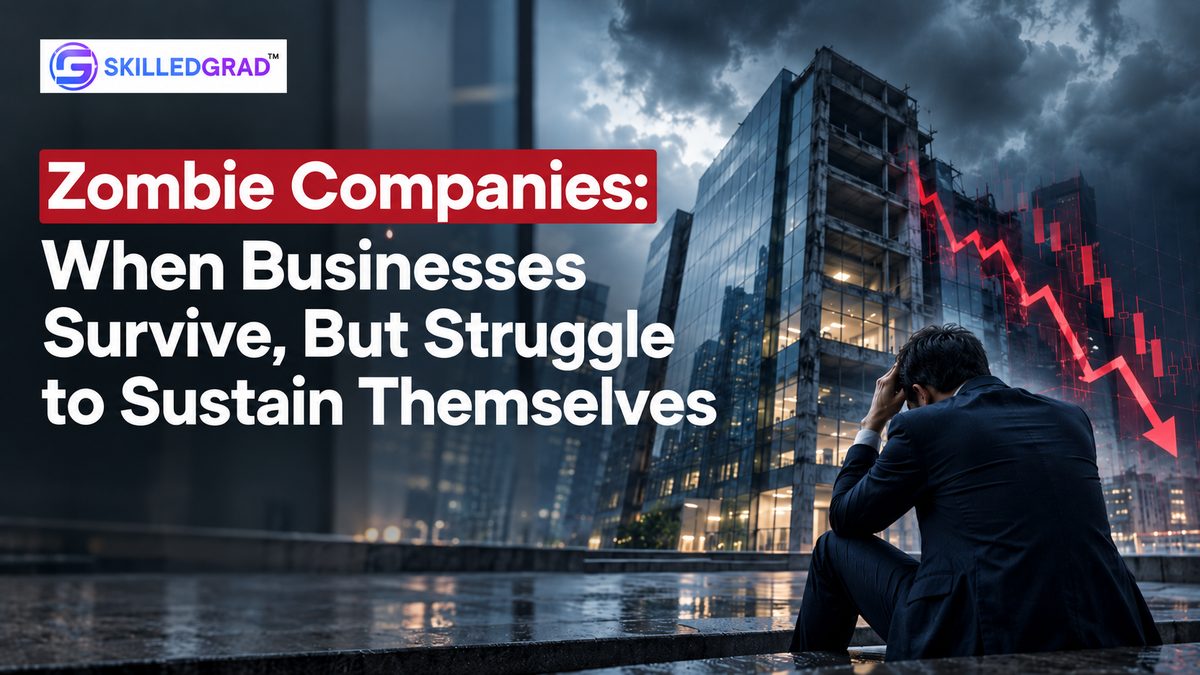

A zombie company is an established business that keeps operating despite persistently struggling to earn enough to cover interest on its debt. Analysts commonly assess this using the interest coverage ratio (ICR = EBIT ÷ interest expense); an ICR below 1 means operating earnings do not cover interest. One weak year alone is not enough: persistent difficulty is the concern. In a Dun & Bradstreet study of around 6,000 listed Indian companies, zombie firms (ICR below 1 for three consecutive years) were 5.5% in 2025, down from 8.1% in 2017.
How a Classroom Discussion Led to an Interesting Financial Lesson
Some finance concepts are easy to understand in a textbook. Others become interesting only when you see them happening in the real world.
Contents
- How a Classroom Discussion Led to an Interesting Financial Lesson
- What Is a Zombie Company in Financial Analysis?
- Understanding Zombie Companies With a Simple Example
- Does an Interest Coverage Ratio Below 1 Make a Company a Zombie?
- Zombie Companies in India: What the Latest Research Reveals
- Five Financial Indicators Analysts Should Examine
- Why This Matters to Investors and Lenders
- The Bigger Lesson From Our Skilledgrad Classroom
- Key Takeaways
- Frequently Asked Questions About Zombie Companies
- Research Note
- Conclusion
Recently, while teaching financial analysis in ACCA class, I discussed the concept of zombie companies with my students at Skilledgrad. The term caught their attention. How can a business be called a zombie when it still has customers, employees and revenue?
What started as a seemingly unusual term quickly became a discussion about debt, profitability, interest payments and whether a business can truly sustain itself. That is exactly what makes real-world finance interesting.
What Is a Zombie Company in Financial Analysis?
A company may have customers, employees, assets and revenue, and still struggle to earn enough to cover its interest costs. It may survive through refinancing, fresh borrowing, shareholder support or asset sales. None of these, on its own, proves that the core business is financially healthy.
So the interesting question is not merely whether the company is still operating. It is whether the business is getting stronger or simply finding new ways to stay afloat.
Understanding Zombie Companies With a Simple Example
| Particulars | Amount |
|---|---|
| Revenue | ₹100 crore |
| Operating Profit (EBIT) | ₹8 crore |
| Interest Expense | ₹12 crore |
| Interest Coverage Ratio | 0.67 times |
How to Calculate the Interest Coverage Ratio
Interest Coverage Ratio = EBIT ÷ Interest Expense = ₹8 crore ÷ ₹12 crore = 0.67 times.
What Does an Interest Coverage Ratio Below 1 Mean?
The company generates only ₹0.67 of operating earnings for every ₹1 of interest expense. Its operating earnings cannot fully cover interest costs. It may continue operating through refinancing, additional debt, promoter support, asset sales or restructuring. These actions may buy time, but its underlying business must eventually become financially stronger.
EBIT is not the same as operating cash flow. Cash reserves and liquidity can allow a business to make payments even while interest coverage remains weak, so analysts should consider both earnings and cash.
Does an Interest Coverage Ratio Below 1 Make a Company a Zombie?
Not necessarily. Businesses can have a weak year because of a recession, commodity prices, rising interest rates, industry slowdowns or one-off costs. Persistent difficulty is more important than a single poor period.
The Three-Year Rule Used in the Dun & Bradstreet Study
| Classification | Criterion used in the study |
|---|---|
| Stressed company | ICR below 1 in a single year |
| Zombie company | ICR below 1 for three consecutive years |
The three-year classification is specific to this study; researchers may use different definitions.
Zombie Companies in India: What the Latest Research Reveals
Dun & Bradstreet examined approximately 6,000 listed companies during 2015 to 2025 and reported a reduction in the proportion of zombie firms.
| Indicator | Finding |
|---|---|
| Zombie firms, 2017 | 8.1% |
| Zombie firms, 2025 | 5.5% |
| Combined stressed and zombie firms, 2025 | 14.2% |
| Peak combined stressed and zombie share | 23.5% |
The decline suggests improved debt-servicing capacity across the companies studied. Financial stress has not disappeared, however, and the findings should not be generalised to all Indian businesses.
Can Zombie Companies Recover?
Among 764 previously classified zombie firms whose status could be assessed in 2025, the study reported:
| Financial status | Share |
|---|---|
| Fully recovered | 38.9% |
| Temporarily recovered | 16.0% |
| Still classified as zombies | 32.3% |
The percentages do not account for every firm in the assessed group. The findings show that a zombie classification need not imply inevitable failure, but a temporary improvement is not the same as lasting financial health.
Five Financial Indicators Analysts Should Examine
1. Interest Coverage Ratio
Can the company generate enough operating earnings to cover interest? Persistently weak coverage deserves attention.
2. Operating Cash Flow
Does the business generate cash from regular operations? Profits may not translate into cash because of working capital needs.
3. Debt Levels
Is borrowing increasing faster than the company’s earning capacity? Repeated borrowing amid weak operations is a warning sign.
4. Debt Repayment Capacity
Can the company repay principal as well as interest? Check liquidity, maturity schedules and cash flow available for debt servicing.
5. Underlying Business Performance
Is profitability improving sustainably? Refinancing can offer temporary relief, but long-term health requires durable operating improvement or lower obligations.
Why This Matters to Investors and Lenders
For a lender, persistent weakness raises questions about debt recovery. For an investor, it raises questions about future cash flows and the possibility of further borrowing or dilution. But the practical test remains the same: can the underlying business improve enough to stand on its own?
The Bigger Lesson From Our Skilledgrad Classroom
The most useful takeaway from our classroom discussion was not the word “zombie”. It was the change in the question students began asking. Instead of stopping at “Is the company making a profit?”, they asked, “Is it generating enough earnings and cash to sustain itself?”
This is why I like connecting formulas to actual business developments. An interest coverage ratio may seem like just another calculation, until it helps explain the stress that real companies face.
Key Takeaways
Zombie companies experience persistent difficulty covering interest with operating earnings.
An ICR below 1 indicates EBIT is insufficient to cover interest expense.
One weak year does not automatically make a firm a zombie.
In the Dun & Bradstreet study, the share of zombie firms fell from 8.1% in 2017 to 5.5% in 2025.
Some zombie companies recover, but not all recoveries are permanent.
Cash generation, debt levels, interest coverage and sustainability must be evaluated together.
Frequently Asked Questions About Zombie Companies
What is a zombie company in simple terms?
A company that keeps operating despite persistently struggling to generate enough operating earnings to cover interest expense.
What is the interest coverage ratio of a zombie company?
An ICR below 1 for an extended period is a common sign. The cited Dun & Bradstreet study used three consecutive years.
Can a profitable company be a zombie?
Yes. Positive EBIT can still be lower than interest expense; for example, EBIT of ₹8 crore and interest of ₹12 crore produces an ICR of 0.67.
Can zombie companies recover?
Yes. Stronger operations, lower debt or restructuring may support recovery, although not every recovery lasts.
Why are zombie companies important in financial analysis?
They show why analysts must study interest coverage, leverage, cash generation and long-term sustainability instead of revenue and profit alone.
Research Note
Definition and data note: “Zombie company” has no single universal definition. The Dun & Bradstreet study used an ICR below 1 for three consecutive years; its separate “stressed” classification covered an ICR below 1 in any single year. The percentages relate to its sample of listed firms, not all Indian businesses. Source: Business Standard, 27 September 2026.
Conclusion
The term zombie company sounds dramatic, but the lesson is simple: a company can continue operating without being financially healthy. The figures from India show both encouraging recoveries and continuing distress. The point of financial analysis is to look beneath headline revenue and profit and test the sustainability of a business.
The objective is not just to know finance. The objective is to see finance happening around you.
Prepare with Skilledgrad
Classroom coaching at Purasaiwakkam and Tambaram, with structured classes, question practice, tests and one-on-one mentoring. Talk to us about the batch and exam window that suit you.