
ACCA is a specialised professional qualification in accounting, audit, tax and finance that you can start after Class 12 and study alongside a B.Com or BBA. An MBA is a broader two-year postgraduate management degree that usually needs a graduation and an entrance exam. Neither guarantees a salary: choose ACCA for a finance and accounting career, an MBA for general management.
At a glance
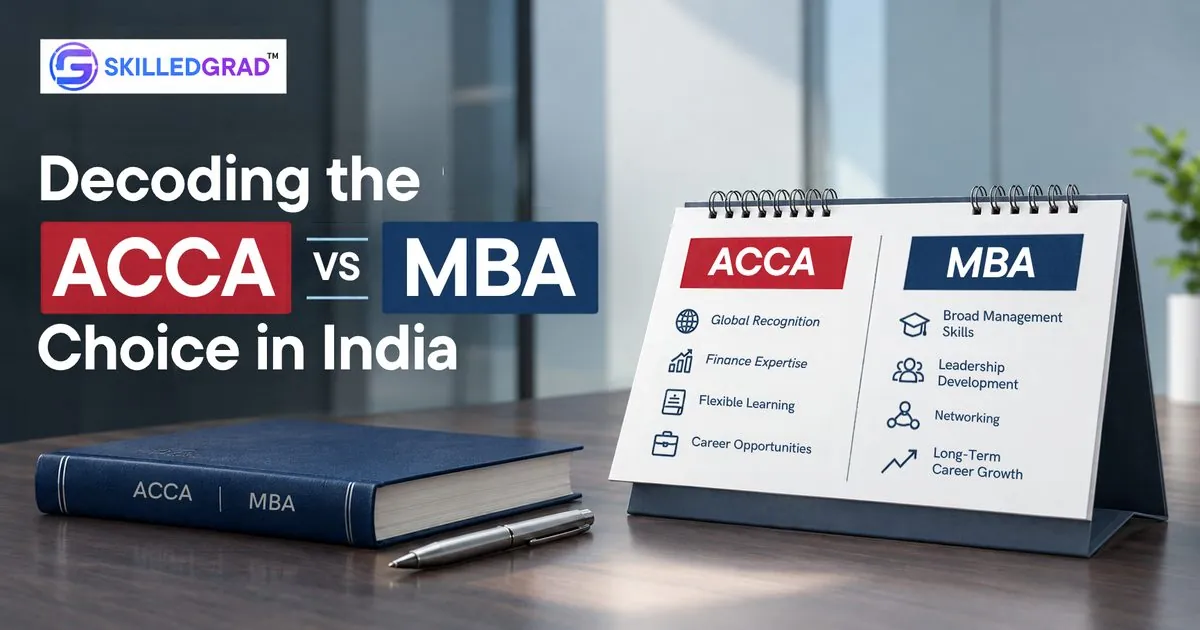
ACCA vs MBA: ACCA specialises in accounting, audit, tax and finance; an MBA develops broader management skills across business functions.
Contents
- At a glance
- 1. ACCA vs MBA: Qualification and Recognition
- 2. ACCA vs MBA: Quality and Recognition in India
- 3. ACCA vs MBA Eligibility: After Class 12 or Graduation?
- 4. ACCA vs MBA: Course Structure and Subjects
- 5. ACCA vs MBA Career Opportunities in India
- 6. ACCA vs MBA Fees and Course Duration
- 7. Which Is More Difficult: ACCA or MBA?
- 8. ACCA vs. MBA: Which Should You Choose?
Eligibility: eligible students can begin ACCA after Class 12 and alongside B.Com/BBA; a typical MBA requires an undergraduate degree.
Duration and fees: ACCA examination pace and costs vary by exemptions and attempts; most full-time Indian MBA programmes run for two years, with institution-specific fees.
Career outcomes: neither ACCA nor MBA guarantees a salary or placement; experience, skills, institution and job role matter.
Best fit: choose based on your preferred career path, not qualification popularity alone.
Read on for the detailed comparison and important considerations.
Choosing the right professional qualification is an important step towards building a successful career. For students interested in finance, accounting and business management, two popular options are ACCA (Association of Chartered Certified Accountants) and MBA (Master of Business Administration).
Both qualifications offer valuable career opportunities, but they differ significantly in their curriculum, eligibility requirements, cost, duration and career prospects.
So, which is better: ACCA or MBA in India? Let’s compare both options to help you make an informed decision.
If ACCA is the route you are leaning towards, see our ACCA course in Chennai.
1. ACCA vs MBA: Qualification and Recognition
ACCA
The Association of Chartered Certified Accountants (ACCA), established in 1904, is a globally recognised professional accountancy body.
ACCA has more than 257,000 members and 530,000 students and affiliates across approximately 180 countries.
The qualification focuses on developing professional expertise in accounting, financial reporting, taxation, auditing, financial management and business strategy.
Its international recognition makes ACCA an attractive choice for students interested in building careers with multinational companies, accounting firms and global finance teams.
MBA
A Master of Business Administration (MBA) is a postgraduate qualification offered by universities and business schools in India and internationally.
MBA programmes provide a broad understanding of business functions, including finance, marketing, operations, human resources, strategy and leadership.
In India, management education is also offered through Post Graduate Diploma in Management (PGDM) programmes by various institutions.
The recognition, curriculum quality and career opportunities associated with an MBA or PGDM depend considerably on the institution and the programme.
2. ACCA vs MBA: Quality and Recognition in India
ACCA
ACCA follows a common professional qualification framework, with examinations and assessment standards administered by the global professional body.
This provides a consistent approach to professional accountancy education across countries. The curriculum emphasises technical knowledge, professional ethics and the practical application of accounting and finance concepts.
MBA
The quality of MBA education in India varies significantly across institutions.
Leading management institutions, including IIMs, ISB, FMS and XLRI, are recognised for their academic rigour, industry connections and recruitment opportunities.
Other institutions may offer quality programmes, but their faculty, industry exposure, placement records and employer recognition can differ substantially.
Consequently, while comparing ACCA with an MBA, students should consider the specific business school rather than treating all MBA programmes as equivalent.
3. ACCA vs MBA Eligibility: After Class 12 or Graduation?
ACCA
Students can begin their ACCA qualification journey after completing Class 12, subject to ACCA's eligibility requirements.
Students can also pursue ACCA alongside an undergraduate degree such as B.Com or BBA.
Graduates and candidates holding certain professional qualifications may be eligible for exemptions from specific ACCA examinations, depending on their previous qualifications.
This flexibility allows students to begin developing professional accounting and finance knowledge relatively early in their careers.
MBA
An MBA generally requires candidates to have completed an undergraduate degree from a recognised institution.
Admission requirements vary between business schools. Many institutions consider entrance examinations such as CAT, XAT, CMAT, MAT or GMAT.
Leading business schools typically have competitive admission processes that may include entrance examination scores, academic records, interviews and assessments of the applicant’s profile.
Other institutions may have comparatively less competitive admission requirements.
4. ACCA vs MBA: Course Structure and Subjects
ACCA
Under the existing ACCA qualification structure in 2026, students generally complete 13 examinations across three levels:
• Applied Knowledge: Three examinations covering business, management accounting and financial accounting.
• Applied Skills: Six examinations covering areas such as financial reporting, taxation, audit, performance management and financial management.
• Strategic Professional: Four examinations, including two compulsory papers and two options.
Students must also fulfil professional ethics and practical experience requirements to become ACCA members.
Important update: ACCA is introducing a redesigned qualification in 2027, with changes to the examination structure and additional emphasis on employability skills and emerging areas of professional practice.
MBA
An MBA provides broader business and management education.
The curriculum typically includes finance, marketing, operations management, organisational behaviour, human resources, business strategy, economics and leadership.
Students may choose specialisations such as finance, marketing, business analytics, operations or human resources.
Most traditional full-time MBA programmes in India last two years and include internships, case studies, group projects and industry interactions.
5. ACCA vs MBA Career Opportunities in India
ACCA
ACCA is particularly suitable for individuals interested in developing specialised careers in accounting and finance.
Potential careers include Financial Reporting Analyst, Auditor, Tax Consultant, Management Accountant, Financial Analyst, Finance Business Partner, and Risk and Compliance Professional.
ACCA professionals may find opportunities with accounting firms, multinational corporations, financial institutions and organisations operating global finance functions.
In India, career opportunities are influenced by examination progress, practical skills, work experience and employer requirements.
ACCA also offers a dedicated career platform through ACCA Careers. Unlike a conventional MBA programme, ACCA is not tied to a single university campus placement system. Students generally apply independently or seek assistance through training institutions and recruitment platforms.
MBA
An MBA opens opportunities across business functions, depending on the student's specialisation.
Popular career paths include consulting, finance, marketing, business development, operations, human resources and general management.
An advantage of pursuing an MBA from a leading business school is access to established campus recruitment programmes and employer networks.
However, placement opportunities and starting salaries vary substantially among institutions. Students should evaluate placement reports, median salaries, recruiting companies and roles before enrolling.
6. ACCA vs MBA Fees and Course Duration
ACCA
ACCA is often a comparatively affordable route for students seeking a professional qualification in accounting and finance.
The total cost includes initial registration, annual subscription, examination fees, applicable exemption fees, learning materials and coaching expenses.
Actual expenditure varies depending on examination attempts, exemptions, tuition arrangements and the time taken to complete the qualification.
Many students aim to complete ACCA examinations in approximately two to three years, although the duration depends on academic background, exemptions and individual progress.
Students can generally schedule their studies around graduation or employment. However, ACCA has examination time-limit rules, particularly at the Strategic Professional level. Students should review the applicable rules when planning their qualification.
MBA
The cost of pursuing an MBA in India varies widely depending on the institution and programme.
Government-supported institutions may offer relatively affordable programmes, while several leading private business schools charge considerably higher fees.
Students must consider accommodation, living expenses and the potential opportunity cost of taking a break from employment.
Most traditional full-time MBA programmes require approximately two years of study. Executive, part-time and online MBA programmes provide alternatives for eligible students and working professionals, although their learning experiences and recruitment opportunities may differ.
7. Which Is More Difficult: ACCA or MBA?
ACCA
ACCA requires a strong understanding of accounting, financial reporting, taxation, auditing and financial management.
The examinations test technical knowledge and the ability to apply concepts to practical business situations.
Professional-level examinations can be particularly challenging because they require analytical thinking, professional judgement and integrated application of knowledge. Consistent preparation and examination practice are important for success.
MBA
The difficulty of an MBA depends on the institution, curriculum and student's academic background.
Students must understand multiple business disciplines and apply concepts through case studies, assignments, presentations and group projects.
At leading business schools, the academic workload, competition and placement preparation can be demanding.
The key difference is that ACCA emphasises specialised accounting and finance knowledge, while an MBA develops broader business and managerial capabilities.
8. ACCA vs. MBA: Which Should You Choose?
Choose ACCA if:
• You are interested in accounting, auditing, financial reporting, taxation or corporate finance.
• You want a globally recognised professional accountancy qualification.
• You prefer to study alongside graduation or employment.
• You want specialised finance and accounting expertise.
Consider an MBA if:
• You want a broader career in management, consulting, marketing, operations or business leadership.
• You are interested in general management and leadership capabilities.
• You can gain admission to a business school with strong academics, industry connections and placements.
• You prefer a structured postgraduate management programme.
Your next step
Both ACCA and MBA offer valuable career opportunities, but they serve different professional objectives.
ACCA is a specialised professional accountancy qualification suited to students looking to build careers in accounting, auditing, financial reporting and finance.
MBA is a broader management qualification that prepares students for careers across business functions, including finance, marketing, consulting and operations.
Neither qualification automatically guarantees a higher salary or better career prospects. Outcomes depend on education, practical skills, experience and opportunities.
Ultimately, the right qualification is the one that aligns with your interests, career goals, financial considerations and long-term professional ambitions.