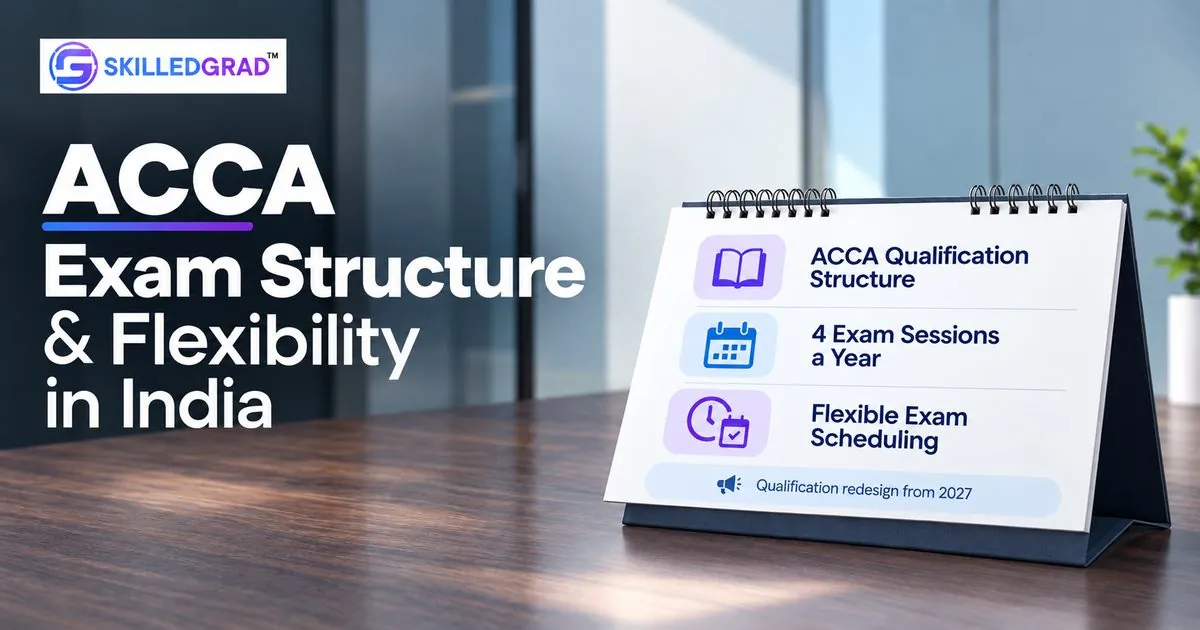

ACCA session exams run four times a year, in March, June, September and December, while early papers such as BT, MA, FA and LW (English and Global variants) can be taken on demand. You can enter up to four exams per session and eight distinct exams a year, choosing the order within a level. Only Strategic Professional passes carry the seven-year expiry rule.
At a glance
Exam structure: the current ACCA qualification has Applied Knowledge, Applied Skills and Strategic Professional levels; exemptions can affect your route.
Contents
- At a glance
- 1. ACCA Exam Structure and Flexibility: What Can You Choose?
- 2. ACCA Exam Sessions and Dates: March, June, September, December
- 3. ACCA On-Demand Exams vs Session-Based Papers
- 4. How Many ACCA Papers Can You Attempt in a Year?
- 5. ACCA Exam Progression Rules: Can You Choose Paper Order?
- 6. ACCA Seven-Year Rule: Which Exam Passes Expire?
- 7. Can you change or cancel an ACCA exam booking?
- 8. ACCA After Class 12: Exam Planning Alongside B.Com or BBA
- 9. What will change in ACCA examinations in 2027?
- 10. How Skilledgrad supports flexible ACCA study planning
- Frequently Asked Questions
Exam dates: session-based papers are offered in March, June, September and December; eligible on-demand papers can be taken at other times.
Attempt limits: generally up to four exams per exam cycle and eight distinct exams in a calendar year, subject to ACCA rules.
Exam order: students have choices within a level, but modular progression rules still apply.
For Class 12 and college students: use exam flexibility to schedule ACCA papers around B.Com or BBA coursework and university examinations.
2027 transition: check official ACCA guidance for the redesigned qualification and credits for prior passes.
Below, we explain the examination rules and how to build a realistic study plan.
One reason students consider the ACCA Qualification is the freedom to plan examinations around school-to-college transitions, university semesters and personal commitments. But flexibility does not mean every paper can be taken on any day, or in any order. Some exams are available on demand; others run in scheduled sessions, and progression and booking deadlines still apply.
This guide explains what you can choose, what ACCA requires, and how to create a sensible study plan, particularly if you are beginning ACCA after Class 12 or alongside B.Com or BBA.
If you want classroom support while you plan your papers, see our ACCA course in Chennai.
1. ACCA Exam Structure and Flexibility: What Can You Choose?
Four scheduled exam sessions each year: March, June, September and December.
On-demand computer-based examinations for eligible early-stage papers.
Choice of examination sequence within a level, subject to modular progression rules.
Options to prepare alongside a degree through weekday or weekend study.
Ability to spread examinations across sessions rather than take every paper together.
The key is to distinguish examination flexibility from examination rules. You can plan your pace, but you must still meet entry requirements, booking deadlines and ACCA’s progression limits.
2. ACCA Exam Sessions and Dates: March, June, September, December
ACCA schedules session-based examinations during five-day exam weeks in March, June, September and December. Exact dates, subject availability and booking deadlines differ by session and should always be checked on the official ACCA timetable. Some country-specific variants may be offered in fewer sessions.
For a college student, the four-session structure creates opportunities to plan around semester exams. For example, if your university examinations fall in April and November, June or September may be easier targets, depending on your preparation and the precise college calendar. This is an illustration, not a universal recommendation.
Official timetable and deadlines
3. ACCA On-Demand Exams vs Session-Based Papers
| Feature | On-demand computer-based exams | Session-based computer-based exams |
|---|---|---|
| When | Available across the year, subject to centre availability | Scheduled in March, June, September and December |
| Papers under the 2026 structure | BT, MA, FA and LW (English/Global variants) | PM, TX, FR, AA, FM and Strategic Professional papers; other LW variants |
| Booking | Through authorised on-demand exam arrangements | Through the ACCA exam planner by session deadlines |
| Results | Displayed immediately; uploaded to account subsequently | Normally published around six weeks after the session |
| Best planning use | Complete early papers when ready | Plan revision backwards from a fixed sitting |
Not every version of Corporate and Business Law (LW) is on demand; check the version applicable to you. Availability is also subject to the examination centre and ACCA’s rules.
4. How Many ACCA Papers Can You Attempt in a Year?
Under ACCA’s current rules, students may enter a maximum of four examinations in an exam cycle and a maximum of eight distinct examinations in a calendar year. These are ceilings, not recommended targets. Taking fewer papers can be sensible when you have college examinations, internships or other commitments.
Example: a first-year B.Com student may aim for one ACCA paper at a time until they understand the workload. Another student with a stronger accounting foundation may consider a faster pace. Neither approach guarantees a pass; the right pace depends on preparation and available study hours.
5. ACCA Exam Progression Rules: Can You Choose Paper Order?
The 2026 ACCA Qualification has three exam levels: Applied Knowledge (BT, MA, FA), Applied Skills (LW, PM, TX, FR, AA, FM) and Strategic Professional (SBL, SBR and two options chosen from AFM, APM, ATX and AAA). Students may choose the order of papers within each level, but examinations must be entered in modular order.
For example, if you want to enter a paper from the next level while papers remain outstanding in your current level, ACCA requires you to enter all outstanding papers in the current level as well. This is an entry rule; it does not mean attempting the next level early is the best academic choice.
Selecting papers with related concepts, rather than selecting the maximum allowed, is often a better planning strategy. The Ethics and Professional Skills Module is also an important part of the current qualification, and ACCA recommends completing it before Strategic Professional examinations.
6. ACCA Seven-Year Rule: Which Exam Passes Expire?
The seven-year rule applies to Strategic Professional examination passes, not to Applied Knowledge or Applied Skills passes. Once you pass your first Strategic Professional paper, you have seven years to complete the remaining Strategic Professional examinations. A Strategic Professional pass older than seven years may expire if you have not finished that level.
For instance, an Advanced Financial Management pass earned in December 2020 would ordinarily expire in December 2027 unless the remaining Strategic Professional examinations had been completed. This does not mean every ACCA student has only seven years from registration to finish the entire qualification.
7. Can you change or cancel an ACCA exam booking?
You normally book session examinations through the exam planner in myACCA. Before the standard entry deadline, you can cancel an entry and, if necessary, rebook a different time, location or variant subject to availability and the applicable fees. After that deadline, changes or cancellation are generally not permitted, subject to limited legal or exceptional provisions in ACCA’s terms.
Practical booking checklist: confirm the paper and variant; check the approved centre and exam date; review your college calendar; book before the standard deadline; save confirmation and review your attendance docket.
8. ACCA After Class 12: Exam Planning Alongside B.Com or BBA
A practical timetable starts with your college obligations, not with the maximum number of ACCA papers allowed.
Map the next two university semesters, including likely examination and assignment periods.
Identify whether the target ACCA paper is on demand or session based.
Estimate weekly study time you can sustain alongside college.
Select one examination target and leave sufficient time for revision, practice questions and mocks.
Review readiness before committing to a booking; do not treat an available exam window as a deadline to rush.
Revisit the plan after every sitting, especially before the 2027 qualification transition.
Illustrative pathway: a student entering the first year of B.Com could start with an Applied Knowledge paper and book an on-demand attempt once adequately prepared. In later semesters, they could plan a session-based paper during a comparatively lighter academic period. This illustration assumes the student meets the applicable ACCA entry requirements and receives no relevant exemptions.
9. What will change in ACCA examinations in 2027?
ACCA is redesigning its qualification in stages. Its published transition timeline identifies June 2027 as the final sitting of the current Applied Skills and Strategic Professional examinations. New Foundations and Knowledge on-demand examinations are scheduled from July 2027, and the first redesigned Expertise and Strategic Professional session examinations are scheduled for September 2027.
The future qualification introduces updated levels and Essential Employability Modules. At Strategic Professional level, students will take two core exams and one options exam rather than two options under the current structure. Students who have already passed examinations will receive applicable transition credits under ACCA’s published arrangements.
If you begin ACCA in 2026, do not assume you must finish the entire old syllabus before mid-2027. Review the official ACCA transition tool and current student guidance for the papers relevant to you, especially if you have exemptions or are close to completing a level.
10. How Skilledgrad supports flexible ACCA study planning
For students balancing ACCA with school-to-college transitions or graduation, an effective plan needs more than a list of exam dates. Skilledgrad offers weekday and weekend ACCA learning options and provides guidance with subject sequencing, exam planning and the exam registration and booking process. The focus is to help students choose a manageable examination schedule alongside their academic commitments.
Explore ACCA coaching at Skilledgrad
Frequently Asked Questions
Can I take ACCA exams at any time?
Only designated on-demand exams can be taken throughout the year, subject to availability. Other exams take place in the four scheduled sessions.
How many ACCA exams can I attempt in one year?
The current limit is eight distinct examinations in a calendar year, with no more than four in an exam cycle.
Can I do ACCA while studying B.Com or BBA?
Yes, many students prepare alongside an undergraduate programme. Your study and examination timetable should account for college commitments and ACCA eligibility requirements.
Is Corporate and Business Law (LW) always an on-demand exam?
No. The English and Global variants are available on demand under the current structure; other variants may be session based.
Do Applied Knowledge and Applied Skills passes expire after seven years?
No. The seven-year expiry rule relates to Strategic Professional examination passes.
Can I postpone my ACCA exam after booking?
Before the standard booking deadline you can normally cancel and rebook, subject to availability. After it, cancellation or transfer is generally restricted.
Will ACCA change in 2027?
Yes. ACCA is introducing redesigned qualifications in stages in 2027, with transition credits for eligible existing passes and exemptions.
Should I wait until 2027 to begin ACCA?
Not necessarily. ACCA advises current and prospective students to review the transition rules and continue progressing where appropriate rather than assume a delay is beneficial.
Conclusion: use flexibility to build a realistic ACCA plan
ACCA’s flexible examination structure can help Class 12 graduates and college students pursue professional accounting education alongside their academic commitments. The biggest advantage is not how quickly you can enter papers, but the ability to choose an appropriate sequence, schedule and study pace. Use ACCA’s published timetable and rules, review the 2027 transition guidance, and create a plan that leaves room for consistent preparation.