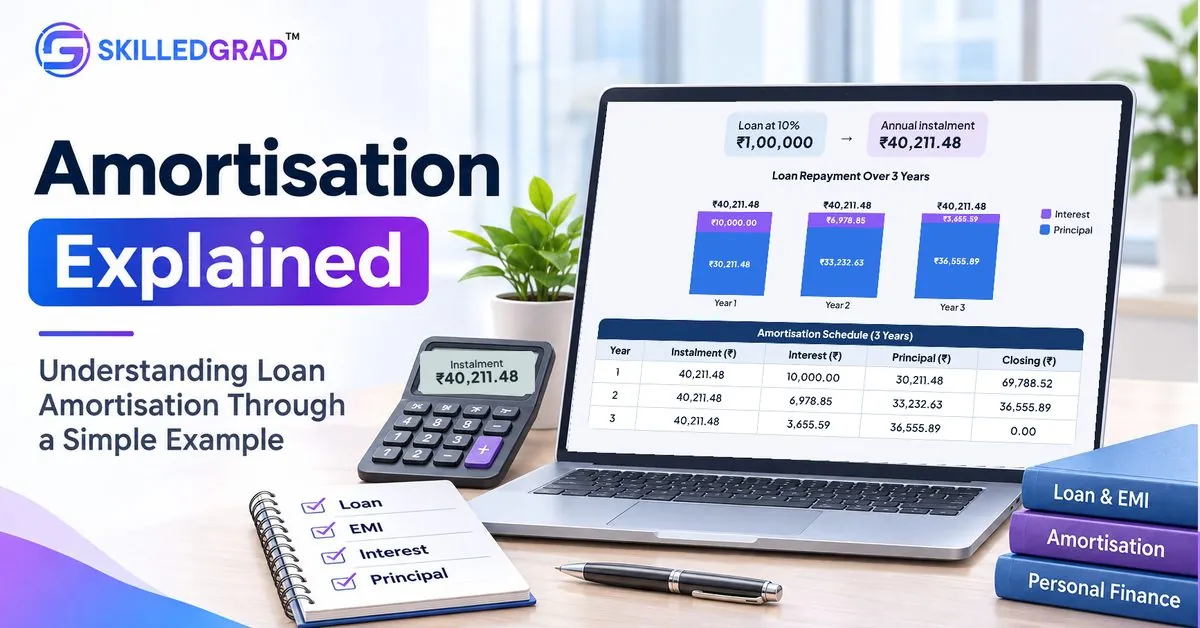

Loan amortisation is the process of gradually repaying a loan over a specified period. Each instalment consists of two components: interest on the outstanding loan balance and repayment of principal. An amortisation schedule helps us calculate these components and track the outstanding loan balance after each payment.
Imagine a company borrows ₹1,00,000 from a bank. It agrees to repay the loan over three years through equal annual instalments.
Contents
The company makes its first payment. Is the entire payment an expense?
No. Part of the payment represents interest on the outstanding loan. The remaining amount reduces the principal borrowed.
This simple distinction is the starting point for understanding loan amortisation.
The same concept also appears in lease accounting, which students encounter in professional finance courses such as ACCA and CFA.
Let’s understand how it works using a practical example.
1. What Is Amortisation?
Amortisation refers to the systematic allocation or reduction of an amount over a period of time.
In loan accounting, it helps us understand how each repayment is divided between interest and the reduction of the outstanding loan balance.
For example, when a company repays a bank loan, the entire instalment is not treated as an interest expense. The interest component is recognised as an expense, while the principal component reduces the liability.
The term amortisation is also used in accounting for intangible assets. However, in this article, we will focus on the amortisation of loans and financial liabilities.
To understand this better, let’s prepare an amortisation table.
2. Loan Amortisation: Let’s Start with Excel
Suppose a company borrows ₹1,00,000 at an annual interest rate of 10%. The loan is repayable over three years through equal annual instalments, paid at the end of each year.
How do we calculate the annual instalment?
We don’t need a complicated mathematical formula. Excel can do this for us.
Using the PMT Function in Excel
Excel has a built-in function called PMT, which calculates the periodic payment required to repay a loan when the interest rate and payments remain constant.
Enter the following formula in Excel:
=PMT(10%,3,-100000)
Excel returns an annual instalment of approximately ₹40,211.48.
Here is what the formula means:
| Input | Meaning |
|---|---|
| 10% | Annual interest rate |
| 3 | Number of annual payments |
| -100000 | Initial loan amount |
The negative sign follows Excel’s cash flow convention. Entering the loan amount as negative makes the calculated instalment positive.
Now that we know the annual instalment, we can prepare the amortisation table.
Preparing the Amortisation Table
The calculation involves three simple steps:
Calculate interest: Opening loan balance × 10%.
Calculate principal repaid: Annual instalment LESS Interest.
Calculate closing balance: Opening balance LESS Principal repaid.
Repeat the same process for each year.
Loan Amortisation Table
All amounts are in ₹.
| Year | Opening balance | Interest at 10% | Annual instalment | Principal repaid | Closing balance |
|---|---|---|---|---|---|
| 1 | 1,00,000.00 | 10,000.00 | 40,211.48 | 30,211.48 | 69,788.52 |
| 2 | 69,788.52 | 6,978.85 | 40,211.48 | 33,232.63 | 36,555.89 |
| 3 | 36,555.89 | 3,655.59 | 40,211.48 | 36,555.89 | 0.00 |
Minor differences may arise from rounding.
Interest vs. Principal Repayment
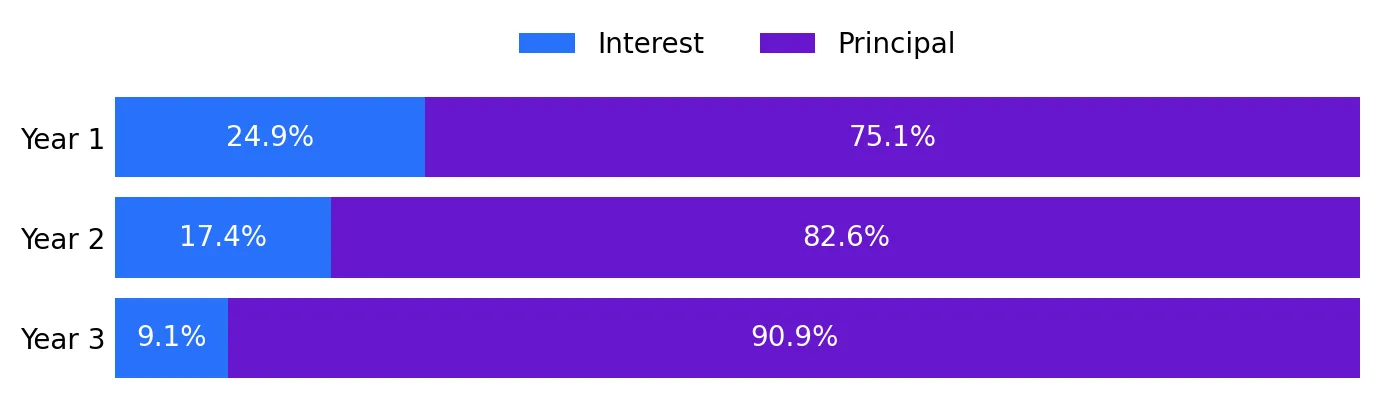
As the outstanding loan balance decreases, a greater proportion of each instalment goes towards principal repayment.
Look at what happens over the three years.
Interest decreases: Interest is calculated on the outstanding balance, which reduces every year.
Principal repayment increases: Since the annual instalment remains constant while interest decreases, more of each payment goes towards principal.
The loan balance becomes zero: By the end of Year 3, the entire loan has been repaid.
Understanding the First Instalment
The company pays ₹40,211.48 at the end of Year 1.
Of this amount:
₹10,000 represents interest expense.
₹30,211.48 reduces the outstanding loan.
The closing loan balance is therefore ₹69,788.52.
The important point: the instalment is not the same as the interest expense. The instalment includes both interest and principal repayment.
3. How Does Loan Amortisation Affect Financial Statements?
Using the same example, let’s understand the impact of the first instalment on the company’s financial statements.
| Particulars | Impact |
|---|---|
| Income statement | Interest expense of ₹10,000 |
| Balance sheet: Loan liability | Reduction of ₹30,211.48 |
| Balance sheet: Cash | Reduction of ₹40,211.48 |
Although the company has paid ₹40,211.48, only ₹10,000 is recognised as an expense in this example.
This is an important distinction between cash outflow and expense recognition in accounting.
4. Where Are These Concepts Used in ACCA and CFA?
Students pursuing professional qualifications such as ACCA and CFA encounter these concepts in various areas of their curriculum.
ACCA: Financial Reporting (FR)
Leases (IFRS 16): Calculating interest on lease liabilities and determining the outstanding lease liability after each payment.
Financial Instruments (IFRS 9): Accounting for financial instruments measured at amortised cost using the effective interest method.
CFA: Financial Statement Analysis (FSA)
Understanding the accounting treatment of long-term liabilities.
Understanding lease liabilities and their impact on financial statements.
Analysing interest expenses and outstanding financial liabilities.
The concept also has practical applications in Financial Modelling, particularly when preparing debt repayment schedules and forecasting interest expenses.
Understanding the Concept Rather Than Memorising the Formula
Amortisation becomes easier when we understand the logic behind the numbers rather than memorising formulas.
Excel helps us calculate the annual instalment. The amortisation table then shows how the payment is divided between interest and principal repayment.
The same basic idea also helps us understand lease liabilities and other financial instruments in professional accounting and finance courses.
Once the concept is clear, the calculations become much easier to follow.
Technical References
ACCA: What Is a Financial Instrument?
CFA Institute: Topics in Long-Term Liabilities and Equity
Prepare with Skilledgrad
Classroom coaching at Purasaiwakkam and Tambaram, with structured classes, question practice, tests and one-on-one mentoring. Talk to us about the batch and exam window that suit you.