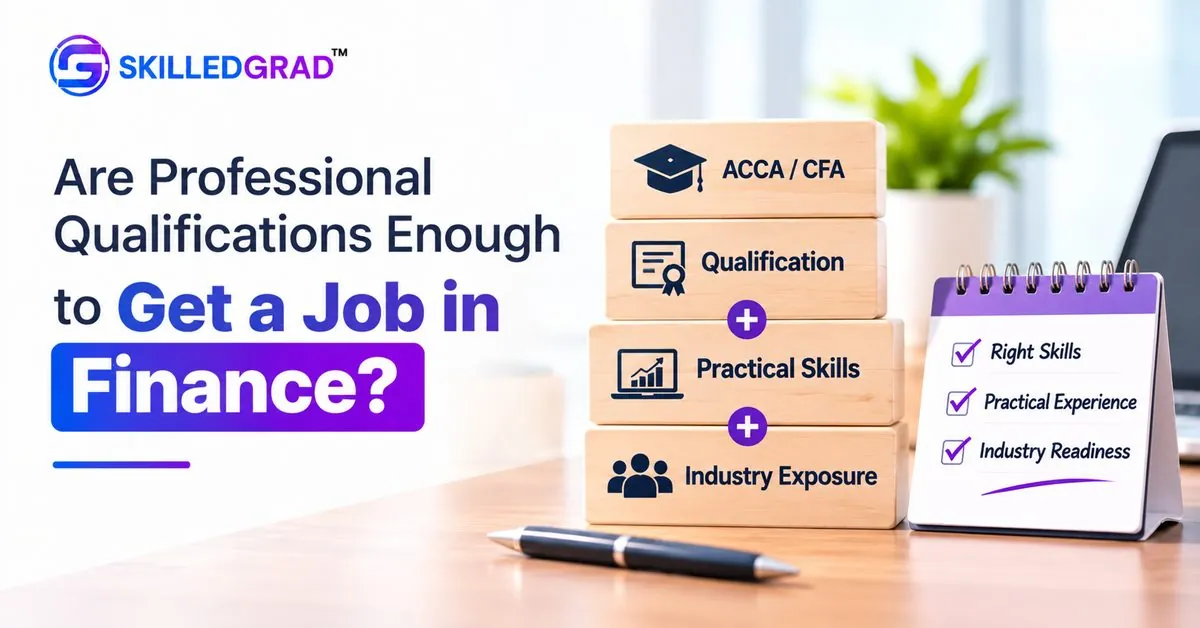

Professional qualifications such as ACCA, CFA and CMA provide valuable knowledge and can help candidates qualify for job opportunities. However, a professional qualification alone does not guarantee employment. Employers also look for candidates who can apply their knowledge, solve problems, use relevant tools and communicate effectively.
Developing practical skills alongside professional studies helps students strengthen their understanding, explore different career opportunities and prepare for the transition from education to employment.
Contents
- A Professional Qualification Is a Launching Pad, Not a Job Guarantee
- Job Descriptions Are Often Recruiters' Wish Lists
- What Practical Skills Do Employers Look for in Finance Careers?
- Professional Bodies Are Also Recognising the Importance of Practical Skills
- What If You Are Not Sure Which Finance Career to Pursue?
- Why Learning Skills Alongside a Professional Course Is an Advantage
- Demonstrate Your Skills Through Projects, CVs and Interviews
- The Bigger Lesson: Qualifications and Skills Should Work Together
- Frequently Asked Questions
A Professional Qualification Is a Launching Pad, Not a Job Guarantee
Many students pursue professional qualifications with the expectation that completing the examinations will naturally lead to a good job.
While qualifications are undoubtedly valuable, the reality of recruitment is more complicated.
Educational qualifications are like launching pads. They can get you to the interview platform, but what matters during the interview and thereafter is the skill set you bring to the job.
Professional qualifications such as ACCA, CFA and CMA develop knowledge across different areas of finance, accounting and business. However, employers recruit candidates to perform specific job responsibilities rather than for their qualifications alone.
An equity research analyst, an FP&A analyst and a financial reporting analyst may all need a good understanding of finance, but their day-to-day responsibilities can be very different.
The underlying knowledge may overlap, but the practical application differs.
This is why some students struggle to secure the jobs they want despite completing demanding professional qualifications.
There is a difference between knowing a concept and being able to apply it.
Job Descriptions Are Often Recruiters' Wish Lists
One of the challenges we have identified while guiding students is the way they interpret job descriptions.
A job description may contain a long list of requirements, including technical knowledge, software proficiency, industry experience, analytical skills and communication abilities.
For a fresher, this can be intimidating.
However, job descriptions are often closer to a recruiter's wish list than a checklist that every applicant must satisfy completely. Employers describe their ideal candidate, even though finding someone who meets every requirement may be difficult.
Some requirements are essential for performing the job, while others are desirable or can be developed after joining.
Another important point is that students should not evaluate a job opportunity based on its title alone.
For example, the designation of Financial Analyst in one organisation may involve budgeting, forecasting and management reporting, while the same designation in another organisation may involve company analysis, valuation or investment research.
Despite having the same job title, the responsibilities and skills required can be significantly different.
Read the job description in detail and understand what the role actually involves.
Job descriptions are also a valuable resource for identifying skill gaps. By reading several job descriptions for similar roles, students can identify recurring requirements and understand which skills employers consistently look for.
Ask yourself:
What are the actual responsibilities of the role?
Which skills are essential and which are desirable?
Do I possess the relevant skills?
Can I demonstrate these skills during an interview?
What areas do I need to work on?
Do not reject an opportunity simply because you cannot tick every box in a job description. At the same time, do not assume that a professional qualification will compensate for the absence of essential job-related skills.
What Practical Skills Do Employers Look for in Finance Careers?
The skills required depend on the job profile and its responsibilities.
The following examples illustrate how professional knowledge connects with workplace requirements.
| Career profile | Important practical skills |
|---|---|
| Financial Reporting | Financial statement preparation, accounting adjustments, reconciliations and Excel |
| Audit and Assurance | Application of accounting standards, documentation, internal controls and analytical review |
| Financial Planning & Analysis (FP&A) | Budgeting, forecasting, variance analysis, Excel and management reporting |
| Equity Research | Financial statement analysis, financial modelling, valuation and industry research |
| Investment Banking and Corporate Finance | Financial modelling, valuation, company research and presentations |
| Risk Management | Risk assessment, scenario analysis, financial analysis and reporting |
| Management Accounting | Cost analysis, budgeting, profitability analysis and business decision support |
These are illustrative examples, not exhaustive requirements.
While some skills are specific to particular job profiles, others are relevant across several areas of finance.
Understanding this distinction can help students decide where to invest their time and effort.
Professional Bodies Are Also Recognising the Importance of Practical Skills
An interesting development in professional education is the increasing emphasis on practical and professional skills.
Several professional qualifications now include dedicated components intended to help students connect technical knowledge with workplace applications.
For example, the CFA Program has introduced Practical Skills Modules covering areas such as Financial Modelling, Python, Analyst Skills and portfolio-related applications.
ACCA includes an Ethics and Professional Skills Module and practical experience requirements as part of the pathway towards membership.
These developments indicate that professional bodies themselves recognise the importance of capabilities beyond examination knowledge.
However, whether these skills modules are sufficient to make students job-ready is a separate question.
Completing a module does not necessarily mean that a student can independently perform the tasks expected in a workplace.
The depth of learning, opportunities for application, practice and feedback all matter.
Students should view these modules as valuable components of their education while continuing to develop practical capabilities relevant to their careers.
What If You Are Not Sure Which Finance Career to Pursue?
Not every student knows which career they want to pursue when they begin a professional qualification.
Some are interested in finance but may not yet know whether they would enjoy equity research, investment banking, corporate finance, FP&A or another area.
In such situations, it makes sense to develop transferable skills that are relevant across multiple finance profiles rather than waiting until a specific career has been identified.
Financial Modelling is one such example.
It brings together financial statement analysis, Excel, forecasting, valuation and an understanding of how businesses operate.
These capabilities are useful across several finance roles, although the applications and required depth may differ.
Learning such skills also provides an opportunity to understand the nature of financial and analytical work. Students may discover that they enjoy forecasting business performance, analysing companies or evaluating investments.
Internships, entry-level jobs, conversations with working professionals and short practical courses can also help students explore different career opportunities.
You do not need to have your entire career planned before you start developing relevant skills. Sometimes, learning and applying those skills helps you discover which career you want to pursue.
Why Learning Skills Alongside a Professional Course Is an Advantage
Students often think of professional qualification preparation and practical skill development as two separate stages.
First, complete the examinations. Then, start learning the skills required for employment.
But there can be a significant advantage in developing both together.
Consider a student pursuing CFA who is learning financial statement analysis and valuation.
If the student also builds financial models using the financial statements of actual companies, the concepts begin to connect.
Revenue growth is no longer just an assumption in a textbook. It becomes something that needs to be justified based on business performance, industry conditions and expectations.
Similarly, an ACCA student studying financial reporting can use Excel to work through accounting adjustments and understand their impact on financial statements.
Learning a concept and applying it simultaneously can reinforce both technical understanding and practical ability.
There is another advantage. By the time students begin applying for internships or jobs, they may already have relevant projects and practical work to discuss during interviews.
Rather than starting from scratch after completing a professional qualification, students can gradually build their employability throughout the learning process.
Demonstrate Your Skills Through Projects, CVs and Interviews
Learning practical skills is important, but candidates should also be able to demonstrate them.
For students without substantial work experience, independently completed projects can provide an opportunity to show what they have learnt.
An aspiring equity research analyst, for example, could analyse a listed company, prepare financial forecasts, develop a valuation and write a short investment report.
However, the objective is not simply to create an impressive-looking project for the CV.
Students should be able to explain what they analysed, why they approached it in a particular way, what assumptions they made and what conclusions they reached.
The CV is equally important.
One of the challenges we have observed is that students sometimes prepare lengthy CVs containing qualifications, certificates and achievements that have little relevance to the job they are applying for.
Instead of merely mentioning Financial Modelling under skills, a candidate could briefly describe a company valuation model they have prepared.
A CV should communicate what the candidate can bring to the organisation.
Most importantly, every skill and experience mentioned in the CV should be something the candidate can confidently explain during an interview.
Projects do not replace actual employment experience, but they can help students demonstrate their understanding, initiative and ability to apply knowledge.
The Bigger Lesson: Qualifications and Skills Should Work Together
Professional qualifications remain valuable. They provide structured learning, develop technical knowledge and build a strong foundation for careers in finance and accounting.
Practical skills complement that knowledge.
At Skilledgrad, this is one of the reasons we emphasise developing practical finance skills alongside professional qualifications rather than treating them as separate learning journeys.
Ultimately, students should ask themselves two questions:
What kind of work would I like to do?
Am I developing the knowledge and skills required to perform that work?
If you are unsure about the first question, explore different opportunities and develop transferable skills.
If you know the answer to the first question but are not confident about the second, identify the gaps and work towards closing them.
The objective is not simply to become professionally qualified. It is to become a capable finance professional.
Frequently Asked Questions
Are ACCA, CFA or CMA qualifications enough to get a job?
These qualifications develop technical knowledge and can help candidates meet eligibility requirements. However, employers also consider practical skills, experience, communication and performance during recruitment.
What practical skills are required for finance jobs?
Financial statement analysis, Excel, financial modelling, budgeting, forecasting, valuation and communication are useful across several finance roles. Specific requirements depend on the job profile.
Should students learn practical skills while pursuing ACCA or CFA?
Yes. Developing practical skills alongside professional studies can reinforce technical concepts and help students prepare for employment before completing their qualifications.
Is Financial Modelling useful if I have not decided on a finance career?
Financial Modelling develops transferable skills in financial analysis, Excel, forecasting and valuation that are relevant across several finance roles.
Should I apply for a job if I do not meet every requirement in the job description?
Yes, it may be worthwhile if you meet the essential requirements and can demonstrate relevant capabilities. Job descriptions often contain a combination of mandatory and preferred skills.
How can finance freshers demonstrate practical skills without work experience?
Relevant projects, internships, case studies and independently prepared financial analyses can help students demonstrate their knowledge and ability to apply it.
Prepare with Skilledgrad
Classroom coaching at Purasaiwakkam and Tambaram, with structured classes, question practice, tests and one-on-one mentoring. Talk to us about the batch and exam window that suit you.